
In last month’s blog, I covered some aspects of sequences for writers, and in particular Darrin and Travis Donelly’s ’10-day Screenplay’. This month I want to look again at sequences from a slightly different perspective by looking at the use of ‘tension’.
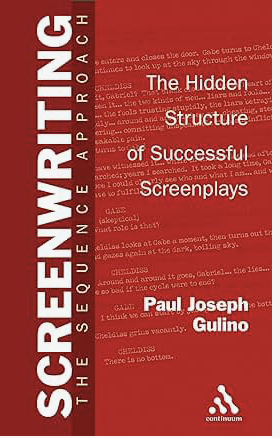
In Paul Joseph Gulino’s book, ‘Screenwriting the sequence approach – The hidden structure of Successful Screenplays’, Gulino explains how and why the sequence approach developed.
Academically, the sequence approach was taught at Colombia University in the early early eighties. Its use as a teaching tool developed through the experiences of Frank Daniel, the inaugural dean of the American Film Institute, and later head of film programs at Colombia University and USC. Daniels found that teaching students to use a three-act structure didn’t provide them with enough guidance. In particular, the challenge of writing an hour-long second act was too daunting for them without further guidance. So breaking down the screenplay into 8 or more shorter more manageable self-contained sequences made sense. Each sequence had its own purpose and dramatic tension and contributed to the overall main tension.
So what is dramatic tension? Most writers understand importance of creating ‘conflict’ in a story. But ‘conflict’ is what the characters experience. Tension is the emotion that the audience (or reader) experiences. It’s that thing that drives audience (or reader’s) expectations about the outcome of the story and holds their attention – a kind of vicarious anxiety as to the future plight of the characters they have bonded with. So how do you create it?
Frank Daniel described it as “somebody wants something badly and is having difficulty getting it.” Daniel articulated two kinds of dramatic stories: chases and escapes, but as Gulino explains, these are two versions of the same thing: either someone wants something and is having trouble getting it, or is trying to escape something and having trouble doing so.
If a character wants something, then a question is implied – will the character get it or not? This is known as the dramatic question and the tension it creates is known as the Main Tension. It’s a kind of glue that holds the story together. The first act will set up the dramatic question. The second act plays out the Main Tension and often resolves the dramatic question, but not the story. In the third act a new dramatic tension asserts itself and is finally resolved.
Take Star Wars New Hope. The first act establishes the dramatic question. Will Luke and Obi Wan get the Death Star plans to the rebels? They achieve this at the end of the second act. The third act is a new question and tension – will the Luke and the rebels destroy the deathstar?
So lets look at Gulino’s approach to sequences. Each sequence accounts for approximately 15 minutes of movie time (or 15 pages of the script).
Sequence A
It’s all about the setup; who, what, when and where: an introduction to the main characters and an early hook to capture the interest of the audience or readers. The sequence usually ends with the inciting incident (or catalyst) that sends the main character and their world into turmoil.
Sequence B
This sequence is all about setting up the dramatic question which will create the Main Tension for the second act. By the end of this sequence we will know what the story is going to be about. The sequence usually ends dramatically as the main character takes up or is forced to take up challenge associated with the Main Tension. In Star Wars New Hope, Luke finds his aunt and uncle dead and has no other course of action but to go with Obi Wan to take the Death Star plans to the rebels.
In act 2, sequences C-F play out the Main Tension and answer the dramatic question.
Sequence C
Sequence C is the main character’s first attempt to resolve the underlying problem. They choose the easiest solution and it leads invariably to a bigger problem.
Sequence D
Sequence D is an attempt to get back on course by more desperate measures. It leads to the First Culmination – a kind of mini-climax or reversal at the Mid Point of the story. The main character either wins or succeeds in their actions but neither result resolves the Main Tension.
Sequence E
The after-effects of the first culmination leads to a further unexpected complication. The stakes rise and the main character stiffens their resolve. It could also mean the possible introduction of new characters and opportunities.
Sequence F
Having exhausted all the available options, the main character finally focuses on the right approach, and this finally leads to the resolution of the Main Tension. Gulino comments that there is misconception that this is necessarily a low point for the main character. Of many of the examples he’s uses, it is not.
Sequence G
The resolution of the Main Tension is not the resolution of the story. There are consequences that lead to a new dramatic question and tension to be resolved in the final act.
Sequence H
Sequence H is the final resolution of the story – the climax – and tension is at last finally resolved. It also invariably contains an epilogue or coda tying up any loose ends and giving the audience a chance to catch its breath and come down emotionally from the intensity of the experience.
So the second Act is driven by the dramatic question and the Main Tension. And the third Act introduces the a new question and the final tension. But each sequence also has its own dramatic question and tension. Maybe that sounds a little complicated. But if you read Gulino’s book he gives examples of sequences taken from a number of successful movies including: Toy Story, The shop around the Corner, Double Indemnity, Nights of Cabiria, North by Northwest, Lawrence of Arabia (16 sequences), The Graduate,One Flew Over the Cuckoo’s Nest, Air Force One, Being John Malkovitch, The Fellowship of the Ring.
Identifying the beginning or end of a sequence can sometimes be difficult, particularly when the story contains subplots. But the point is that the method is a tool for the writer to use. How they break down the story into manageable units is up to them. Maybe 8 sequences is not enough, and you need more (like Lawrence of Arabia). Basically, the method should be adapted by the writer in the way that best works for them. Personally, I like the sequence method as it reflects the way I think about a story. Intuitively, sequences links together the scenes driven by a common purpose, and the sequences together map the course of the story. They can also be written separately as bite sized chunks of story rather than as a long continuous stream of events.
Tell me what you think and whether you have used the method.
 JMJ Williamson